Your Choice of Product
Introduction
Gypsum board production line design is a systematic engineering process that integrates material handling, chemical processing, mechanical forming, thermal drying, automation, and environmental control. A well-designed production line directly influences product quality, operational stability, energy consumption, and long-term manufacturing costs. Hengshui Decheng Machinery & Equipment Co.,Ltd focuses on providing customized gypsum board production line designs that align with raw material conditions, target capacity, product specifications, and local regulatory requirements.
The primary objectives of production line design include:
Stable and continuous output
Consistent board thickness, density, and surface quality
Efficient energy utilization
Flexible adaptation to different board types
Safe and environmentally compliant operation
Design must balance production capacity with investment cost and future expansion potential. A production line designed only for short-term output may limit long-term competitiveness.
The design process begins with raw material analysis. Gypsum board production typically uses calcined gypsum (stucco), paper liners, water, and additives.
Key design considerations include:
Type and purity of gypsum (natural gypsum, FGD gypsum, recycled gypsum)
Moisture content and particle size
Storage volume and buffer capacity
Feeding accuracy and contamination prevention
Raw material silos, feeders, and conveyors are arranged to ensure uninterrupted supply and controlled flow into the mixing system.
If the production line includes integrated calcination, the calciner must be designed to match board line capacity. Key parameters include:
Calcination temperature range
Residence time
Heat source selection
Dust and exhaust handling
For lines using externally supplied stucco, storage and pneumatic conveying systems are designed to maintain powder flowability and prevent hydration.
The slurry system is the core of gypsum board production. Design focuses on accuracy and consistency.
Automatic dosing units precisely control gypsum, water, foaming agents, and additives
Mixing equipment is selected based on required slurry viscosity and setting behavior
Surge tanks stabilize flow to the forming section
The design must ensure uniform slurry quality, as variations directly affect board strength and surface appearance.
The forming section defines the physical characteristics of the gypsum board.
Key design elements include:
Paper unwinding systems with tension control
Slurry distribution head for uniform deposition
Forming belts and tables for thickness control
Adjustable line speed
Line length is designed according to slurry setting time and desired production rate. Insufficient forming length may cause deformation during cutting.
After initial setting, boards are cut to standard lengths.
Design considerations include:
Synchronization between line speed and cutting frequency
Edge shaping requirements (tapered or square edges)
Transfer conveyors to minimize board damage
Efficient handling design reduces breakage and improves downstream drying efficiency.
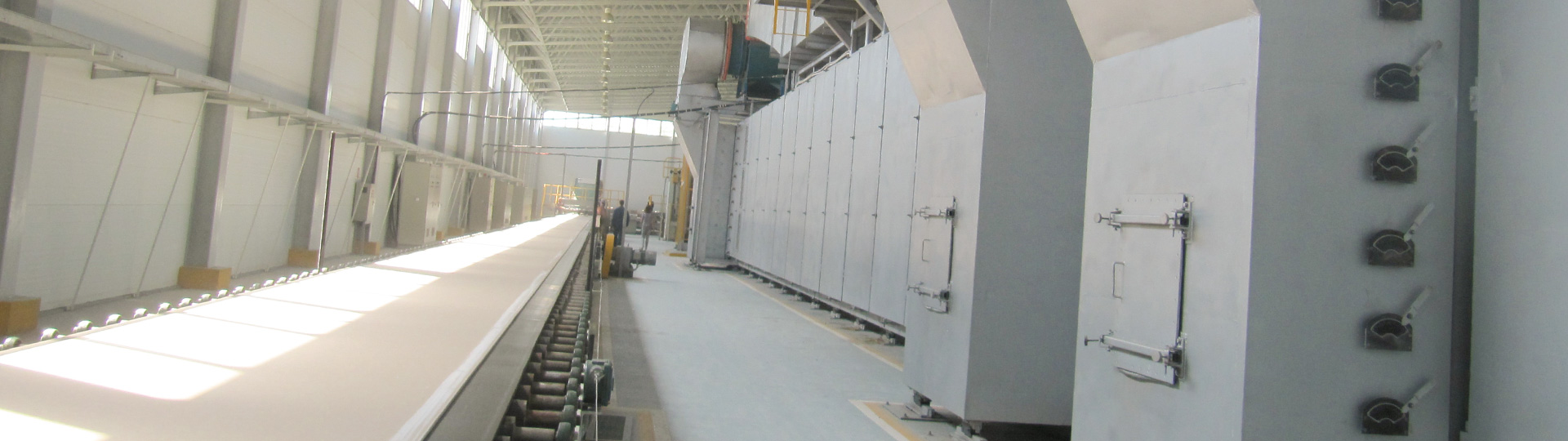
The drying system removes free moisture while maintaining board integrity.
Dryer design includes:
Multi-zone temperature control
Airflow direction and velocity
Energy source selection
Residence time calculation
Proper dryer design ensures uniform moisture content and avoids defects such as warping or surface cracking.
Modern gypsum board production line design emphasizes centralized automation.
PLC systems coordinate feeding, forming, cutting, and drying
Human-machine interfaces provide real-time monitoring
Sensors measure thickness, moisture, temperature, and speed
Automation reduces dependence on manual operation and improves repeatability.
Environmental compliance is an integral part of line design.
Dust collection systems are positioned at material transfer points
Noise control measures are applied to high-speed equipment
Fire prevention systems protect dryer and calcination areas
Hengshui Decheng Machinery & Equipment Co.,Ltd integrates these systems during the design stage to ensure regulatory compliance.
A well-designed gypsum board production line allows for future capacity increases or product diversification.
Design provisions may include:
Reserved space for additional dryers or mixers
Modular control systems
Adjustable forming widths
This approach reduces future modification costs and downtime.
Conclusion
Gypsum board production line design is a comprehensive engineering task that affects every stage of manufacturing, from raw material handling to finished board packaging. Careful planning of equipment layout, process flow, automation, and environmental systems is essential for stable and efficient operation. Hengshui Decheng Machinery & Equipment Co.,Ltd provides production line designs that focus on reliability, adaptability, and long-term operational value.
Processing Demand Survey
x